
Pipeline Safety and Public Awareness
At Colonial Pipeline, operating safely and promoting best safety practices in our communities are top priorities. We believe that education is vital for creating awareness about pipelines and ensuring pipeline safety in the areas where we live and work. Our Public Awareness program is dedicated to enhancing the public’s understanding of these crucial topics by actively promoting damage prevention efforts and highlighting the importance of state 811 One Call laws to protect our communities.
In case of emergency, call 800-926-2728.
For non-emergencies, call 678-762-2487, or email us at [email protected]
Community Partners Program
Call Before You Dig
Laws in every state require commercial excavators and landowners to call 811 before digging to have underground utility lines located and marked. One free, easy call gets your utility lines marked AND helps protect landowners and contractors from injury, expense, and penalties. If you’re planning any type of digging or excavating project, please visit the 811 website for more information on locating underground infrastructure.

Helpful Resources
General Resources
Farmers
You’ve been farming your property for years and know the lay of the land, but do you know the depth of underground utilities on your property? Can you be sure that farming activities will not damage underground lines?
Over time, erosion or other land contour changes can reduce soil cover, potentially exposing you and your workers to danger should you strike a pressurized refined liquid petroleum products line.
Typical farm activities that can damage underground pipelines include:
- Deep plowing
- Drain tile installation or repair
- Cleaning drainage culverts or creeks
- Construction of a pond or well
- Installation of fence posts
- Sub-soiling
- Tree and stump removal
It took you years to build your farm. Don’t take any chances. Please call 811 for any activity that involves digging.
First Responders
Pipeline incidents are rare, but in the event they do occur, we partner with local agencies for the protection of people, property, and the environment. The information we share with emergency preparedness liaisons and the partnerships we develop through continuous training help keep the communities we serve safe.
As a first responder, it’s important to know where Colonial pipelines and facilities are located within your jurisdiction, have the contact information of local Colonial representatives, identify local places of congregation in your area that could be impacted by a pipeline event, and ensure your local emergency plans include response and evacuation measures to address pipeline emergencies.
VIDEOS
Excavators
Did you know that even a small tear in a pipeline coating during excavation can result in a future spill? Excavation damage is a leading cause of pipeline incidents in the U.S., resulting in service disruptions, project delays, fines, injuries, and even death. Excavators can be held responsible for repair, loss of service, and clean-up costs.
That’s why it’s crucial to know what’s below the ground before beginning any excavation project. Laws in every state require excavators to call 811 before digging to have underground utility lines located and marked. Some communities also have local laws that require developers to consult with pipeline operators to discuss safe land use near pipelines. Contact local authorities during the project planning process to understand any local risk-based land use guidelines.
Residents & Businesses
Do you know where Colonial pipelines are located on your property? In your community?
According to the U.S. Department of Transportation, pipelines are the safest and most cost-efficient way to transport liquid energy products. Colonial’s monitoring, inspection, and detection programs are designed to keep our pipelines safe — but those who live and work near our lines can also play an important role in pipeline safety.
VIDEOS
Public Officials
When the Colonial system was built more than 60 years ago, most of our pipelines passed through largely undeveloped areas. But with population growth and expansion, Colonial pipelines can now be found in many communities and populated areas.
If you’re a public official in one of the communities through which our pipeline passes, you have a vested interest in understanding pipeline safety, so you can better communicate and manage decisions for your community. For example, consider:
- Has your community established zoning restrictions for land development near pipelines?
- Does your permitting process promote calling 811 before digging?
- Have you identified local places of congregation that could be impacted by a pipeline event?
- Do local emergency plans include response/evacuation measures to address pipeline emergencies?
Schools
Do you know if there are pipelines located on or near your school property? Do you know the signs and hazards of a pipeline release? Do you have an emergency response plan for your school?
Although pipelines are considered the safest method of fuel transportation, emergencies can occur. We want to help keep your school, students, and staff safe. Please consider sharing these resources with administrators and office staff, teachers, custodians, bus drivers, crossing guards, students, and parents.
FAQs
What is a right of way?
The pipeline right of way (ROW) is the area of land on top of and on either side of the pipeline that landowners share with Colonial Pipeline. An easement agreement defines the ROW width and gives Colonial the right to bury, maintain, and access the pipeline on landowners’ property for general maintenance and repair. Landowners can obtain a copy of their easement agreement from their local county courthouse or can contact our ROW Records Department at [email protected] with property-related questions.

How do I identify a potential release?
- A dark or oily patch on the ground
- A rainbow film or sheen on water near a river, stream, or lake
- Spots of dead vegetation on the ground
- A vapor cloud
- A strong odor or scent of petroleum products, like the smell of gasoline

What do I do if I suspect a release?
- Without risk of injury, turn off any running equipment, eliminate any ignition source, and immediately leave the area, avoiding use of a vehicle or mechanized equipment.
- Move upwind/uphill of the suspected release. Refined petroleum products are heavier than air and can travel along the ground and may collect in low-lying or confined areas such as sewers, basements and ravines; for safety, seek a higher location.
- Warn others to stay out of the area.
- DO NOT create an ignition source near the suspected release (use a telephone or cell phone, attempt to light a match, start a vehicle engine, turn an electrical appliance on or off, etc.).
- DO NOT attempt to operate pipeline equipment or close valves.
- DO NOT come in contact with any escaped product.
- DO NOT drive into a vapor cloud.
When you are a safe distance away, FIRST call 911 to report the emergency to local responders; THEN call 800-926‑2728 to contact Colonial Pipeline.
What are the safe digging requirements?
If you are excavating near a Colonial pipeline, it is essential that you review the safe digging information and guidelines included below:
- ALWAYS call 811.
- DO NOT begin any excavation near a Colonial pipeline until a Colonial representative has been to the job site to mark the line and discuss any safety concerns. Colonial personnel MUST be physically present for all excavation activities taking place within 15 feet of our pipeline or facilities.
- Use hand excavation for all digging within 2 feet of the pipeline.
- Position excavation equipment a minimum of 3 feet from the edge of the excavation.
- Dig on the “near side” of the pipeline; DO NOT “reach over” the pipeline to excavate.
- DO NOT park any heavy equipment over the pipeline or move heavy loads across the pipeline without first contacting Colonial. You may be required to install protective materials over the pipeline to distribute the weight.
- DO NOT install roads, streets, or driveways across the pipeline without first contacting Colonial. An engineering analysis and encroachment agreement are required for any pipeline crossings.
- DO NOT place fill or perform sub-grading or grading over the pipeline unless approved by Colonial.
- DO NOT blast, drill, bore, or pile drive in the vicinity of the pipeline without first contacting Colonial.
How do I report pipeline safety concerns?
If you witness unsafe conditions, unauthorized excavation or suspicious activity near Colonial’s pipelines or facilities, immediately call our 24/7 emergency number at 800-926-2728 and we will send an inspector to investigate. Examples include:
- Mechanized excavation
- Unauthorized vehicle on the right of way
- Hazardous liquid on the ground
- Petroleum odor
- Exposed pipeline in a creek, river, or stream
- Sink holes
- Trash burning
How do I report damage to a pipeline?
- NEVER cover over a pipeline that has surface damage.
- Immediately report any damage by calling Colonial’s emergency phone number at 800-926-2728.
- Colonial will send a representative to evaluate the extent of the damage and to develop a repair/replacement plan, as needed.
Where are Colonial’s pipelines located?
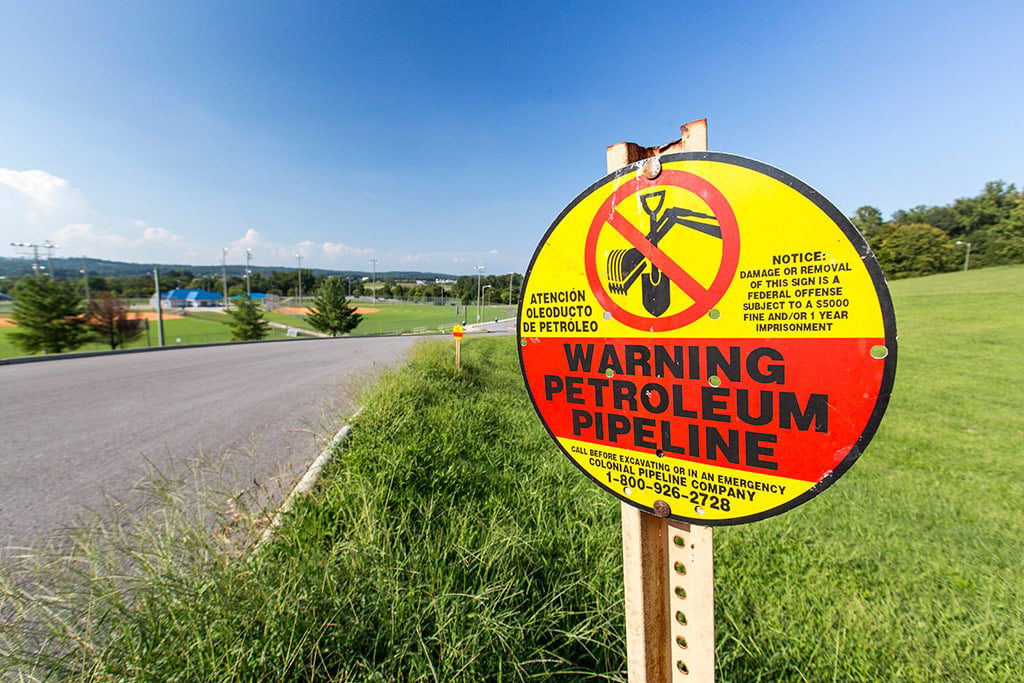
Because most pipelines, like Colonial’s, are buried underground, they may seem invisible. But actually, they are clearly marked by federally required pipeline markers.
Colonial posts easy-to-spot yellow, black, and red markers along the pipeline route to show the approximate location of the pipeline. Markers are also posted at all locations where pipelines pass beneath roads, rivers, streams, and railroad tracks.
These markers identify Colonial Pipeline as the operator, list the product being transported, and display Colonial’s 24 ⁄ 7 emergency phone number.
It is a federal offense to move, remove, or deface any pipeline marker. While markers show the approximate location of the pipeline, their placement within the easement does not show the exact location. Always call 811 before any excavation project to have your pipelines located and marked for free.
You can also view the approximate location of pipelines and obtain contact information for pipeline operators in your area by visiting the National Pipeline Mapping System (NPMS).
* Pipeline location information obtained through NPMS should not be used instead of contacting 811.
What are the hazards associated with your products?
Below are the products Colonial may be transporting or storing in your area and their potential hazards.
| PRODUCT | RELEASE TYPE | VAPORS | HEALTH HAZARDS |
|---|---|---|---|
| Refined Petroleum Products (Gasoline, Diesel Fuel, Kerosene, Home Heating Oil, Jet Fuel) | Liquid | Heavier than air; can spread along the ground; and accumulate in low-lying or confined areas (i.e., sewers, basements, ravines); will float and can be ignited on surface water. Gasoline vapors can travel considerable distances to a source of ignition and flash back, potentially causing fire or explosion. | Vapors may be harmful if inhaled or ingested; may cause skin and eye irritation, dizziness, drowsiness, asphyxia and/or nausea. |
More detailed information can be found on the Safety Data Sheets page.
Still Have Questions?
If you can’t find an answer to your question here or elsewhere on our website, please contact us.
Explore More
Learn more about what we do and how we do it.

Our Commitments
Our Commitments

Safe Operations
Safe Operations

Community Engagement
Community Engagement
Colonial Pipeline believes that when we support the communities we serve, we are creating a better place to work and live.
Read More